 Clan Coleman
Back to Australian Branches ‹--------› Forward to Pat & Norah's Page 2
|
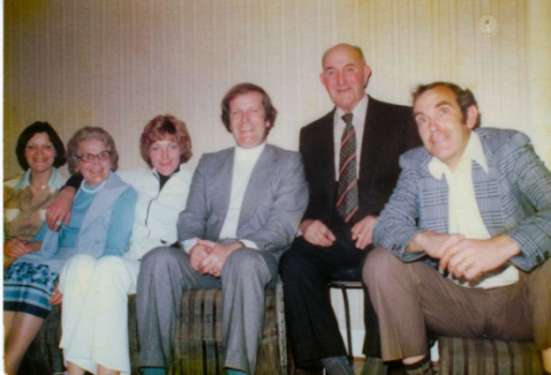
Parents Pat and Norah Coleman's visit to Sydney 1977
With daughters Margaret & Delia and Sons Martin & Mick |
 |
|
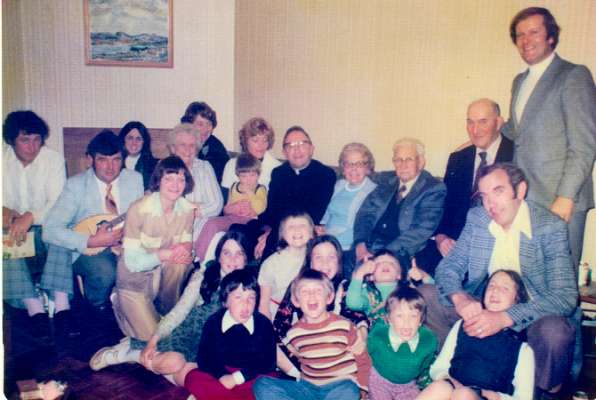
Extended Family
|
 |
|
Given that the year was 1977 and my parents, Pat and Norah Coleman, were in their seventies, this was indeed a rare and wonderful occasion. I had not even entertained the idea of their ever visiting Australia. Of my parents eight children, four ( Mick, Martin, Delia and Margaret) had settled in Sydney and had young families, and so it was a very exciting time for all of us. I was also delighted that my parents were able to meet Patricia's parents, Tom and Margaret Lynch, whose ancestors had come from Patrick's Well and Nenagh respectively. |
|
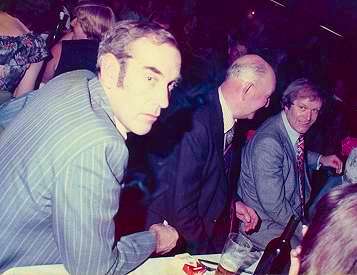
Enjoying a show at the Castle Hill RSL Club with Mick and Dad
|
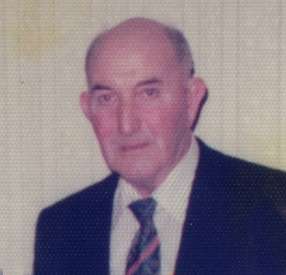
Pat Coleman in Sydney 1977
|
 |
 |
|
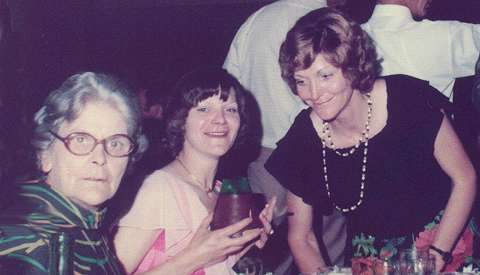
Mum Norah with daughters Margaret and Delia
|
 |
|
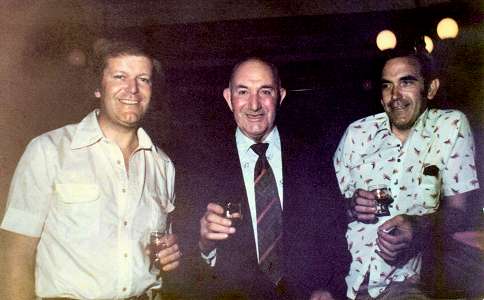
Pat Coleman with sons Martin and Mick enjoying a farewell drink at Mascot Airport as he and Mam are about to return home to Ireland in December, 1977.
|
 |
|
Taken from a taped chat with Dad about his Family - Sydney 1977
|
| This is a written version of a taped chat with my father, Pat Coleman, made during my parents' visit to Australia in 1977. It was made at my sister Delia's place in Baulkham Hills late at night when the Party in their honour was over and everyone else had gone home or was preparing to retire for the night - not the ideal time for an interview of this nature, given the number of calls from my mother for us to go home in order to let the others go to bed. But persevere we did. I should point out, however, that the written language is a most imperfect record of the spoken language, particularly of the conversational level of language. The two forms, written and spoken, are very separate and independent varieties of the language, each with its own set of distinctive and indeed unique characteristics. The stream of consciousness quality alone of conservation virtually makes recording it on paper an impossibility. The nuances, the shifts, the inflections, the intonation patterns, the tone, the pace, the assimilations, the junctures and so on, all are unaccommodated in the written word; and they are after all as much the vehicles of mood and feeling and indeed the real meaning in conversation as the words that accompany them. It's a bit like the skeleton without the body! |
||
| (For purposes of identification, my comments and questions are both indented and italicised) | ||
|
***************************
|
||
| Everything was fine, as Dad had already begun to tell me about his parents, until he realised that he was about to be recorded on tape. The hesitation was all too obvious! Yet the desire to talk about everything took control. | ||
|
How will I start it at all now. Well for a ... |
||
|
Forget about the tape. Don't worry about that. I'll just take it off that later myself |
||
| My Mother's maiden name was Mary Davoren. | ||
| Mary Davoren? | ||
| Mary Davoren | ||
| I thought her name was Bridget. | ||
| No! | ||
| Was it Mary? Is that what it has on the headstone, is it? | ||
| No, it's only my Uncle's name that's on the headstone. | ||
| But I thought her name was on it too. | ||
| No. | ||
| Isn't it? | ||
| No, because that headstone was there before she married my father. | ||
| Mary Davoren | ||
| Mary Davoren | ||
| Where did the Davorens come from? | ||
| (Having left home at the age of thirteen to attend a boarding college that was run by the Missionaries of the Sacred Heart in Cork city, I seemed to have missed the opportunity to learn what perhaps I should have learned about the extended family and the broader local scene.) | ||
| Inshagotree. | ||
| Inshkatree. | ||
| Or Inishmocatreer - that's the way.... | ||
| What do they call it? | ||
| Inishmocatreer. | ||
| Inishmocatreer | ||
| Now wait a minute and I'll spell it for you - I-n-i-s-h-m-a-c-a-t-r-e-e-r. | ||
| Ah, Inishmacatreer | ||
| Inishmacatreer. (Really 'Inishmicatreer' -the plural of 'mac' meaning 'the island of the sons of three) | ||
| Where's that - that's in Lough Corrib, isn't it? | ||
| Yeh, it's in Lough Corrib. | ||
| Did you know her mother? | ||
| I seen her mother , but I was only young. She was Hollran. | ||
| Yeh.. | ||
|
I think Margaret was her mother's name. |
||
| Was it O'Holleran or Holleran? | ||
| Holleran . (spells it) H-o-l-l-e-r-a-n..and she was from a village near the Chapel of Clonbur.. | ||
| So there must be a lot of Hollerans around Clonbur still? | ||
| oooh yes, I know them all- they were all, they were all friends - second cousins like now of me - first cousins of my mother........(That lovely lyrical quality of speech!) | ||
| Right.. | ||
| And they were from a place called - a village near Clonbur within about three hundred yards of the Chapel of Clonbur, a place called Carahakeen.... | ||
| Cara..? | ||
| Carahakeen | ||
| Carahakeen | ||
| And my mother's father - his name was John Davoren- John Davoren. I knew him well. Of course I was young at the time, about you'd say eight or nine years if that. | ||
| And he was from Inishmacatreer? | ||
| Yes, he was there and that was his place, and he married in there then.............. | ||
| How did you get into the Island? | ||
| There's a road going in now. There's a tarred road into it now........... | ||
| From where? | ||
| From Ballynalty, Glencorrib - you go back that ways and it's just, you go down and it's only just about two miles from Glencorrib. | ||
| Is that all? | ||
| That's all. There's a road going all the way in - in by Lough Corrib, in that ways. And that road then - half the road belongs to Mayo County Council an' in County Mayo, and so the inside part of it was done. They wanted to get it tarred with a long time. I seen that road when there was a wooden bridge in it. Now there's a, there's a metal bridge there. So in any case - Galway had the roads done, by-roads before Mayo. But then Mayo had to do the other half. I think the bridgewas in County Galway. The bridge -it's a big high road, and Galway had their own tarred and Mayo had to do the other part of it. (And ‘high' doesn't mean the distance above the water!) | ||
| And you said your mother's father - what was his name again? | ||
| John Davoren. Well... my mother had two brothers ...Pat Davoren, he was married there, and to a woman from above Cross...Billypark. Billypark they called it.... | ||
| Billypark..Where was that place? | ||
| That was just now about a mile from Cross, a mile as you go back now from up where O'Malley's is there ... you follow up a bit there..you go in a byway and it's on the height there, where that John Wall is now there up there - Billypark. There's a burying ground there too in Billypark, and there was ah........... | ||
| Did you say she had two brothers, was it? | ||
| Yes, my mother had two brothers. Pat Davoren, he was my uncle then you know ... and she had another brother then, James Davoren. Oh he was a well educated man . He was travelling, travelling for Singers Sewing Machine you know. I can remember that now even though I was young at the time, and because he came into our house back in Turloughmore, The Neale, and he left one of these small ones , you know, you see like for girls now...they could sew, could sew anything now in the line of say a piece of cloth and shirt and things like that now, you know .... | ||
| That's right, they were a big company of course, Singers. | ||
| Yes. | ||
| And ..right, that was your mother. Can you remember her grandmother at all? | ||
| My mother's grandmother - no. But Margaret...Margaret Holleran was my grandmother. Ah, they were good people. Their cousins were out from a place called Killbride behind the Chapel of Finny, a half parish of Clonbur. One of them had a big place there - there was a wood - he had over 350 acres of land. Oh, he was... | ||
|
So there are a lot of Hollerans around there then? |
||
| Oh yes, there was a lot of Hollerans! A lot of Hollerans - there were Hollerans then in Cole Park, Michael Holleran.... | ||
| Where's Cole Park? | ||
| Cole Park, it's on the south side of Clonbur. There were Kynes up there..you could see them, them lads..they used to play football long'go...seven a side - they used to play in Shrule. Well up from that, about a mile up from that, in a place called Carakeel.. | ||
| Carakeel.. | ||
| Carakeel....there was Hollrans there, a good decent lad or two..But this Michael Holleran - they had a place in an Island in there. They used to go in a boat... Duras. Did you ever hear about Duras? | ||
| No... | ||
| Back from Clonbur, an island. It's a lovely place. I was myself once in it. | ||
| That would be in the Corrrib too? | ||
| The Corrib, Lough Corrib. It's a nice place too in there. There was this Holleran fella..Michael Holleran..he lived within a mile off the island you know. They used to go out by boat, and in any case, he had the most land that was there in the island. He had a lot of land. He had a two storey house there. I was in in it - I was in in it there in Cole Park! | ||
| (Dad is coughing a little - a dry cough - and getting tired) | ||
| But yes, is there anything else now like the..? | ||
| Now what about we'd say your own family? Where were you born? | ||
| I was born at Turloughmore, The Neale | ||
| And who has that land now do you know, Dad? | ||
| That land was our land. My father had 21 Irish acres there. Tommy Holleran, a cousin of our own, had only 5 acres. Jimmy Caulfield had only 5 acres. Johnny Caulfield had only an acre and a half. | ||
| But didn't that land belong initially to Lord....Kilmaine..yes, Lord Kilmaine. | ||
| Kilmaine, yes.. and he wanted the tenants there then - of course they were his tenants - and he had this property in Cahermaculick, and he'd rather see his own tenants getting it , you know. | ||
| This was Lord Kilmaine? | ||
| Lord Kilmaine.. | ||
| And was that the reason you moved to Cahermaculick? | ||
| ‘Twas..well they they... | ||
| Or was it the Land Commission? | ||
| The land..well 'twas the CDB Board that time... | ||
| What's the CDB...? | ||
| Congesterstrict Board... | ||
| ( The Congested District Board was set up to move people from congested areas onto land given up at a price by lords and other members of the crown. ) | ||
| And it was they that built the house in Cahermaculick, and in fact inTurin, Kilernan, and there was a fifteen year limit then, and they'd hand it over to the Land Commission - the Board.. | ||
| All right, well when did your father get that land at Turloughmore? | ||
| Oh, I wouldn't have an idea, because my father was there ever and his father before him, and my Uncle - that headstone that you'd seen there ..in Kilmalora.. | ||
| What was his name? Patrick, wasn't it? | ||
| Patrick...Patrick Coleman -oh, a great man..My Grandmother was there but I couldn't exactly say what her first name was now...Yes...my father's mother was there. | ||
| You can recall her name, can you? | ||
| Well I think myself it could be ..Mary too, Mary Coleman.. (Actually, it was Catherine)Yes, but I hadn't seen my grandfather you know. ( Interruptions of call for us to finish) | ||
| Go ahead; you go ahead! (Plea) | ||
| My father's mother was there when my mother married into there....and me uncle, my father's brother - this man now that the headstone was put for at Kilmalora - that's where the grave is ... | ||
| I have seen that..and I've a good movie of it too.. | ||
| You have but..ah, he was buried there..they were buried inside. That's the Chapel where that headstone is - that was the Chapel. They were buried down there in the Chapel.. the only ones in the graveyard to be buried in the Chapel..they were buried in the Chapel..in the ground there . So I hadn't seen me father's ..... I hadn't seen me grandfather my father's side at all, or my grandmother my father's side but my mother, I used to hear my mother saying, talking about her, that she was a lovely woman. She was a big woman too, a big tall woman, and that she was a nice woman but.. | ||
| You can't recall like your father's father, in other words your grandfather's name ? | ||
| I think his name was John. As far as I can recollect now it was John. | ||
| And what was your father's name? | ||
| John. | ||
| John too..yes, it might have been John. And would they have been in that area for a long time? | ||
| Oh, they were there for years n years n years. | ||
| What..they would have been tenants..? | ||
| There were other Colemans there too but I think they were no relations. (Cousins) | ||
| Around The Neale there now would you have many Colemans related to you? | ||
| Well, well they're all dead now..(Not really) They're all dead now. They weren't..they weren't related. | ||
| You have no Coleman at all now around The Neale related to you, none at all? | ||
| There was a Coleman there ..he had a son there. He's married in The Neale I think. He was but he's a young fellow; he got married there. I think he's a carpenter ..in The Neale... to Mohans in The Neale.. | ||
| And how's he related? | ||
| I wouldn't think he's anything.. His father's name was Peter Coleman, and there was a John Coleman then, a brother of Peter, and he had a place there and if Noel minded his business right, he'd have that place! | ||
| But why did John want to give it to Noel, if they weren't related to you? Why did he want to give it to Noel? | ||
| Ah..He was always like in our house. He'd come you know. John was never married you know. He never got..John Coleman.. | ||
| He must have been related? | ||
|
He used to come into our house now. He'd go to early mass in The Neale I used to hear my mother saying...every Sunday, and he'd come in and they were ..well his father could be something - his father's name ...his father's name was Dan. I knew him well, Dan Coleman. I think like it's a third cousins to my father - third cousins to my father (correct), and ah.. Dan died then you know, and he had two sons, John and Peter. Peter is married twice I think. He was..married twice; he had a little house there in Turloughmore, and John, Dan's son as well, he never got married. But he was always very grateful to my mother like; he'd come in now and they'd both go to early mass, and if he wanted to ah like my mother would be up early and she'd go to half eight mass in The Neale, and he'd be up there, I used to hear her saying, just before she'd go and he'd have a cup of tea , a cup of tea - and what he'd say, ‘A cup of tea would bring you a mile of the road any day'...Ah.ha ha ha!! But he was..he was a perfect scholar! And he'd have the paper then, he'd.. he'd read the paper and he could tell what he read from end to end again after reading it... |
||
| And tell me, tell me, Dad... | ||
| He was a great scholar alright! | ||
| Right, now you were born in Turloughmore there. The house is down now and... | ||
| Ah, you wouldn't know where it was now... | ||
| Kilmalora is where your mother is buried, isn't it? | ||
| Yes and my father..and they're buried down side by side like.. | ||
| Side by side there and Patrick is there too, isn't he? | ||
| Yes, that's right. | ||
| The uncle and so they're all in the same sort of plot there.. | ||
| Yes, yes.. | ||
| And tell me did Patrick ever marry? | ||
| No..Patrick, my uncle, he was in England. | ||
| And where did he die? | ||
| He died at home there with my father. That's before my father got married. | ||
| Ah, did he! He died young. | ||
|
He was dead. My mother never saw him. Well he - I don't think that he was too long dead. We could know the...I forget the year now in the headstone (It was 24-1-1891). We seen it that time.... |
||
| It shows up in my film; so I'll be able to get it... and tell me what year did your father die, John Coleman? | ||
| Well now I see that's a six mark question now too...ah-no-no.. | ||
| Did he die before you came to Cahermaculick, did he? | ||
| No, he died in Cahermaculick. | ||
| Did he. Were you married when he died? | ||
|
No,I didn't get married..my father and mother were dead eighteen months.. a year and a half when I got married.. |
||
| You got married in thirty..eh? | ||
| '33 | ||
| 33..that's right.. | ||
| February, '33 .. | ||
| So they'd have died about eighteen months before that.. | ||
| Yes.. | ||
| So that would have been February ‘32. So they would have died something like... September was it.. '31. (They died in January, 1932) | ||
| Yes, about that now..The two died in the one week. | ||
| What caused it? | ||
| Well..well I suppose my father was sick awhile, but..he recovered a bit, but still he fell ill again.. | ||
| What age was he roughly when he died, do you know, Dad,? | ||
| Well he wasn't the pension age ..about 69 I think as far as I could recollect....He was about that now.(73 according to his Death Certificate) | ||
| And what about Mam? She died the same week, didn't she? | ||
| She did. Well she wasn't she wasn't next as near as old as my father.(63 according to her Death Certificate) | ||
| What did she die from? | ||
| I think she could be about 59.. 58 or 59.. | ||
| What did she die from? | ||
|
Well..the way it was now she went to the father's funeral, and that time..that time, cars were very seldom on the roads - there were no cars. Well we were bringing him to the church - there were two funerals you know - Toole...Pete Toole's brother. The two funerals were one after the other.. |
||
| That's right, Pete Toole's brother died the same time. What was his name? | ||
|
Jim Toole...Jim Toole..and Canon Healey in Kilmaine came out and gave them the Sacrament, and he said he'd run to Toole's first, and he was running back breaking his neck to come in to give the Blessed Sacrament to my father. I was eye witness for that alright, the whole thing, and so the very minute my father got the Blessed Sacrament....from Canon Healey, he died immediately... |
||
| He died.. | ||
| And I was at his bedside when he died .. | ||
| That was nice; that was very peaceful.. | ||
| I was at his bedside, and I made an Act of Contrition into his ear.. | ||
| Good on you; that was lovely.. | ||
|
I did. Well my mother then ..she was at my father's funeral a week before she died and there were a few cars there - that Walter Keady now we were talking about - because we used to deal with them. They were big manure agents, and Tom Gibbons in Shrule - he was the undertaker. The coffin that went with father, 'twas an oak coffin, and it won't be rotten ever I think, because the contractors in Kilmaine and the Welshes (Walshes) - Martin Welsh in Kilmaine you know in the pub there and my father they were cousins, do you see. They were second cousins and the Donlins (Donalds??) over in the Shrule road..they were the same thing and the Welshes and my father and the Heskins in Creevach. The Heskins in Creevach were first cousins of my father.. |
||
| Were they. | ||
|
They were..and ah..'twas an oak coffin. They said they never seen the likes of a coffin going through the village of Kilmaine.. |
||
| Aw that's lovely.. | ||
| Do ye see..'twas beautiful. | ||
Back to Australian Branches ‹--------› Forward to Pat & Norah's Page 2